 ×
×
Video reviews &
AI searchthe playbook
How answer engines read your content, and how one happy customer becomes months of citations, trust and pipeline.
Recorded 25 June 2026 · Lorenzo Bown (HappyClient) & Denis Debacker (Rankshift)
What's inside
Six sections. Click any card to jump straight to it.
Be the answer · GEO
Answer engines - ChatGPT, Perplexity, Gemini - now sit between you and your buyer. Generative engine optimisation is the work of getting them to correctly mention, and recommend, your brand inside the answer. The goal is the same as ever: traffic and leads.
The basics.
What generative engine optimisation actually is, why it is already sending buyers, and why SEO is not dead. Presented by Denis Debacker, Rankshift.
GEO is getting answer engines to recommend you
Generative engine optimisation is the work of getting answer engines - ChatGPT, Perplexity, Gemini - to correctly mention, and ideally recommend, your brand. The goal is the same as it has always been: traffic to your site and leads for your business.
AI search is already sending real buyers.
You can see the same shape in your own server logs and referral sources.
Total ChatGPT referrals, week over week
Source · mostash.com
Homepage referrals, week over week
Pageviews per ChatGPT-referred visit
No, SEO is not dead.
Your GEO strategy is part of your SEO strategy, not a replacement. Think of a circle inside a circle: the basics that work for Google keep working for AI search.
And nobody knows the real prompt distribution. The useful question is how the engine builds its answer, and from which sources.
How an answer engine works.
Nobody knows the real prompt distribution, but we do know the machine. A prompt becomes many searches, the engine judges covers before content, and it never watches your video - it reads the transcript.
A prompt becomes many searches
Watch a real prompt travel through an answer engine. Click the steps, or let it play.
A user asks a question
One real prompt can hold several intents at once: best product, for my situation, near me.
The cover: the gate every page must pass
The engine judges each result by four small signals before it reads a single word. Hover them.
A cover is a set of descriptors that lets an answer engine decide in milliseconds whether a page is worth its time. Hover each part.
How an LLM reads a video
An answer engine never watches your video. It reads it. Same video, two completely different readers:
How to optimise for GEO.
Three pillars: your technical foundation, your own content, and third-party content. Plus the one metric to track - citation rate - and why the winning sources change per industry.
Three pillars, one system
We do not know the prompts, but we know the sources answers are built from.
Your own content
Your website needs something valuable to say, in a way AI can easily understand and distil. Answer first.
Third-party content
LLMs mainly surface brands they meet in trusted sources. Forums, round-ups and expert content directly raise your odds of being included.
Technical foundation
To be cited, your site has to be crawlable and indexable. The SEO basics still matter.
Write it so AI can lift it.
Answer first, in the opening sentence. Real structure. Unique data. A conversational FAQ. Schema markup and honest freshness.
Rankshift wrote one article this way and it was cited in Google’s AI Overview almost immediately, while ranking in the classic results at the same time.
Structured content gets cited fast.
The AI Overview lifted exactly what the structure surfaced: the percentages in the text and the table, and the year in the title. GEO and SEO went hand in hand.
Then triage, per prompt
The metric is citation rate: how often your pages get used as a source. Pick your situation.
Take a prompt you care about. How often is your page cited for it?
Being cited a lot is worthless if the model speaks negatively about you. One big Belgian telecom brand had a top visibility score while several cited articles were negative. Track sentiment next to citations.
Consensus and repetition win.
AI systems don’t only look for facts. They look for consensus and real human experience. That is why review sites, Reddit and YouTube keep showing up.
- Wikipedia47.9%
- Reddit11.3%
- Forbes6.8%
- G26.7%
- TechRadar5.5%
- NerdWallet5.1%
- Business Insider4.9%
- New York Post4.4%
- Toxigon4.1%
- Reuters3.4%
Timestamps make videos citable chapter by chapter.
31% of YouTube citations carry a timestamp, and 78% of timestamped videos get cited chapter by chapter. Google’s AI Overviews jump straight to the moment.
YouTube citations that carry a timestamp
of those get cited chapter by chapter
YouTube and Reddit do the heavy lifting.
Across a representative answer set, the Meta platforms barely register. Spend your effort where the citations actually land.
It is not one-size-fits-all
The dominant sources change completely per industry. Toggle and see.
Publishers, marketplaces and Reddit lead. YouTube is not a given.
Cover share of AI answers per source · Rankshift project data. “(you)” marks the tracked brand.
Video reviews
Turning your happy clients into a marketing machine: the strategy, then the practical side. With Lorenzo Bown, HappyClient.
Video reviews: the strategy.
Why testimonials work, what kind to make, and what, when and how to ask - plus how to convince clients to say yes. Presented by Lorenzo Bown, HappyClient.
Video is the default in 2026.
Not a nice-to-have. The numbers line up across adoption, buying decisions and return on investment.
of businesses now use video as a marketing tool
Source · Wyzowl, 2026
of B2B buyers say a video testimonial convinced them to pick the service
Source · HubSpot Trends, 2025
of marketers say video delivers a positive ROI
Source · Wistia State of Video, 2026
Buyers reach for video first.
Asked how they want to learn about a product, buyers put a short video far ahead of everything else.
“People trust people over brands. We need to see people and hear their experience.”Lorenzo Bown · HappyClient
One interview, 30+ formats.
Four steps: set up the interview, collect the stories (self-served or guided), edit professionally, then turn one story into a content library.
On location with an agency runs 4,000 to 8,000 euro per video. Remote scales to customers anywhere in the world.
Three real customer stories
Straight from the HappyClient library - press play.
Your buyers already wrote the questions.
Pull the interview from where buyers already ask: how people search for you (GEO), your most-clicked FAQ, and your strongest USPs.
If customers keep asking about one topic, the interview question becomes “How did [product] help you with that?” You end up holding video answers to the exact questions your market keeps asking.
The problems people search you for. Answer them on camera.
Your most-clicked questions, answered by a customer.
The integrations, dashboards and features people love.
Ask right after the win.
Willingness to reply decays fast - wait too long and it dies. You have about two weeks.
E-commerce: 3-5 days after delivery. SaaS: after the first milestone or the 30-day mark. Agencies: right after sign-off.
before willingness to reply is mostly gone
Send it when the channel is actually read
Email gets opened Tuesday and Wednesday, 10am to 2pm. Share of peak opens, directional · HappyClient send data 2025.
Personal converts. Email scales.
Take your top 10 to 20 accounts and ask by phone. WhatsApp for warm relationships. Email for volume.
Full automation and A/B testing. Works from 500 to 50,000, but it gets buried in crowded inboxes.
High-volume, low-touch lists.
Open rate over 95%, almost guaranteed to be read, and the reply lands inline. Needs a real relationship.
Warm customers you already chat with.
Hard to say no to someone you trust, and you can answer questions live. Doesn’t scale on its own.
Your top accounts and champions.
Take away the fear
The biggest blocker is imagined effort. Real client reactions, and the tactic behind each:
“I thought it’d take my whole afternoon. It was done in minutes.”
→ It takes about 3 minutes“The example made me feel at ease. I knew what it was supposed to look like.”
→ Share an example“Once I knew I could just redo it, I stopped overthinking it.”
→ Let them record again“Did it from my laptop between two meetings.”
→ From anywhere, any deviceVideo reviews: the practical side.
Editing, the legal part, turning one video into months of content, the right quality and length, AI tools, and the quick tips that stop reviews from leaking away.
Editing starts with the questions.
Great questions make great content. Then the layers: video quality, extra visuals, brand.
And the one that surprises people: for watch time and conversions, audio matters more than video. If you must choose, choose audio.
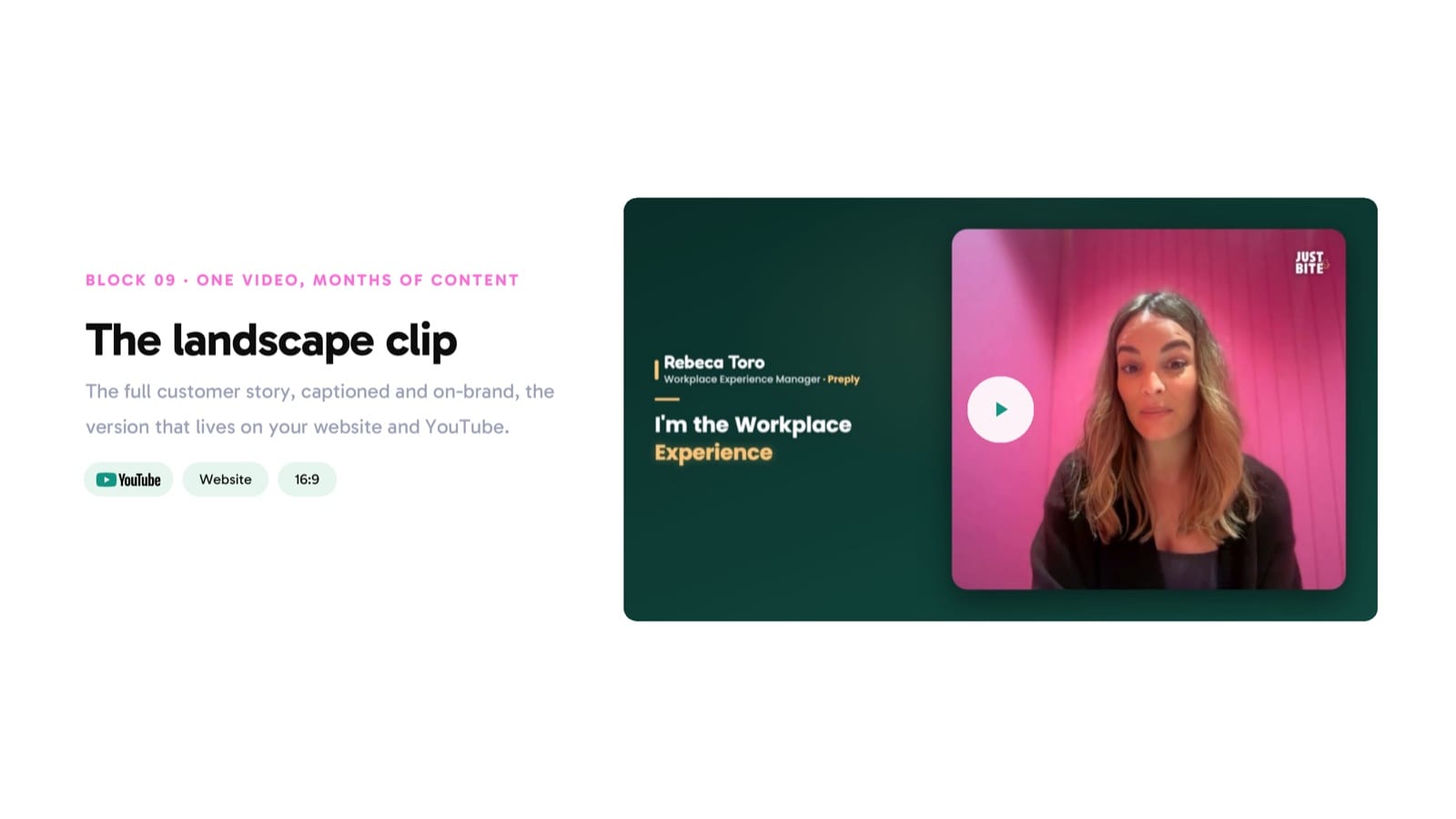
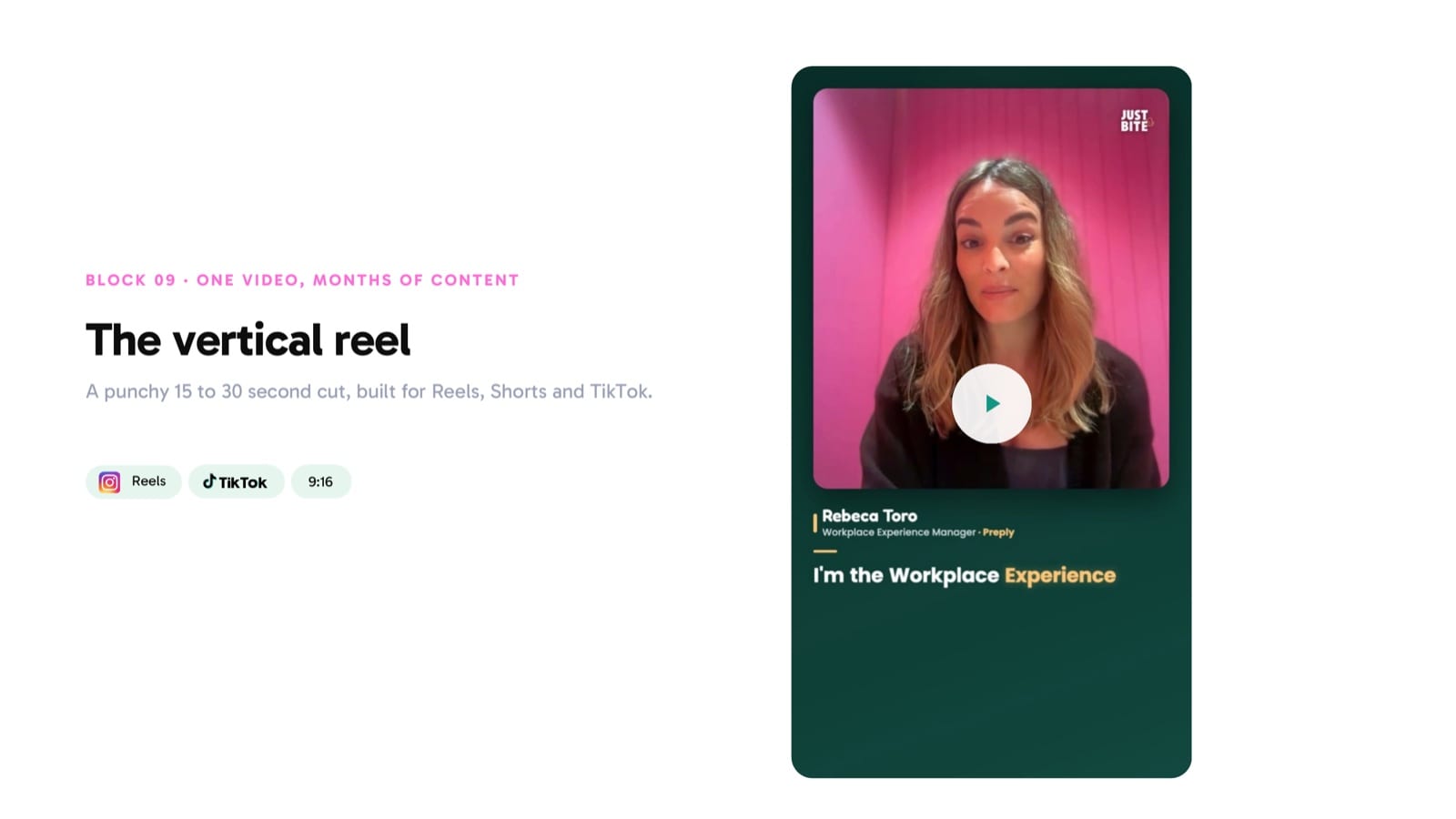
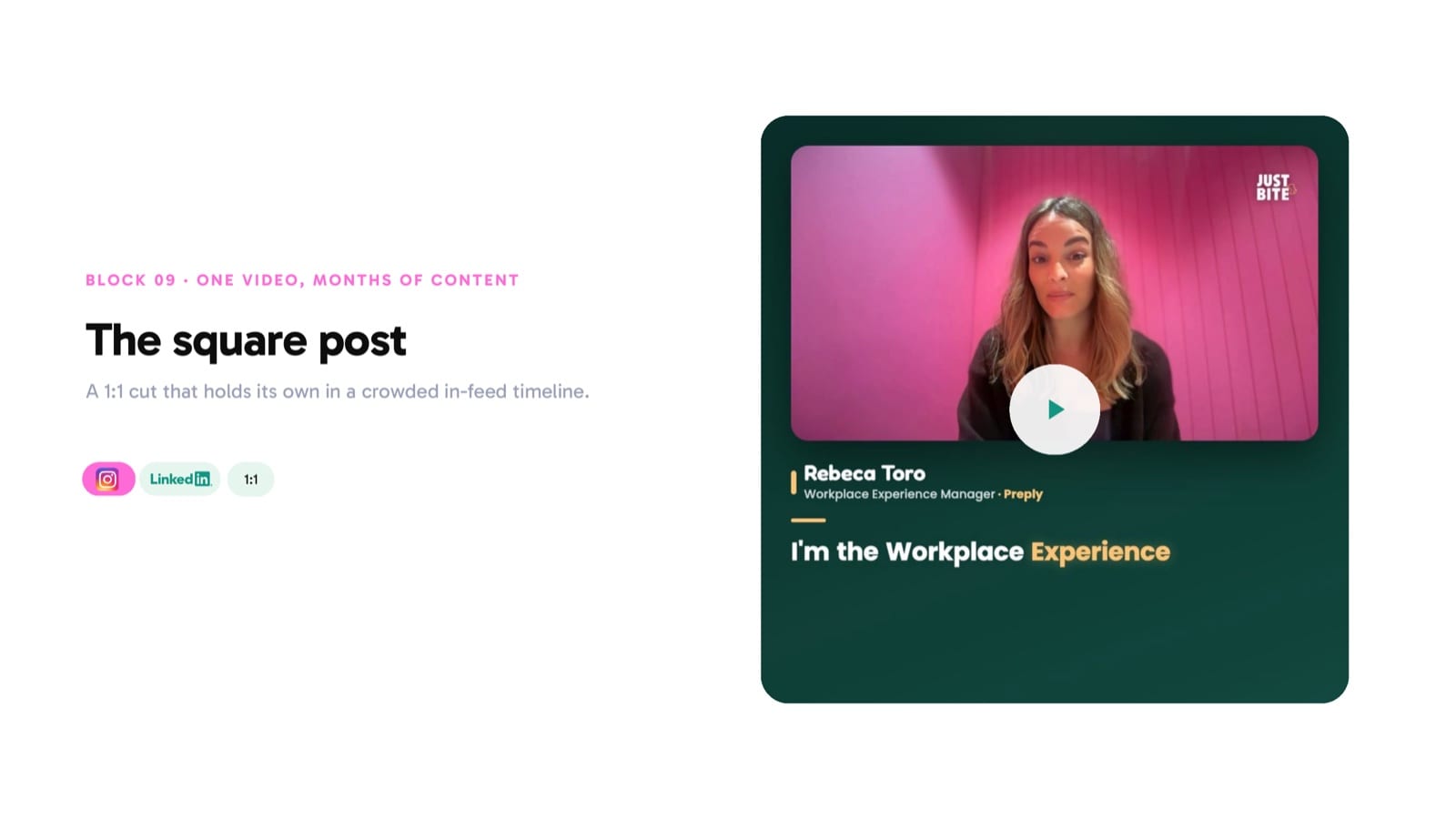
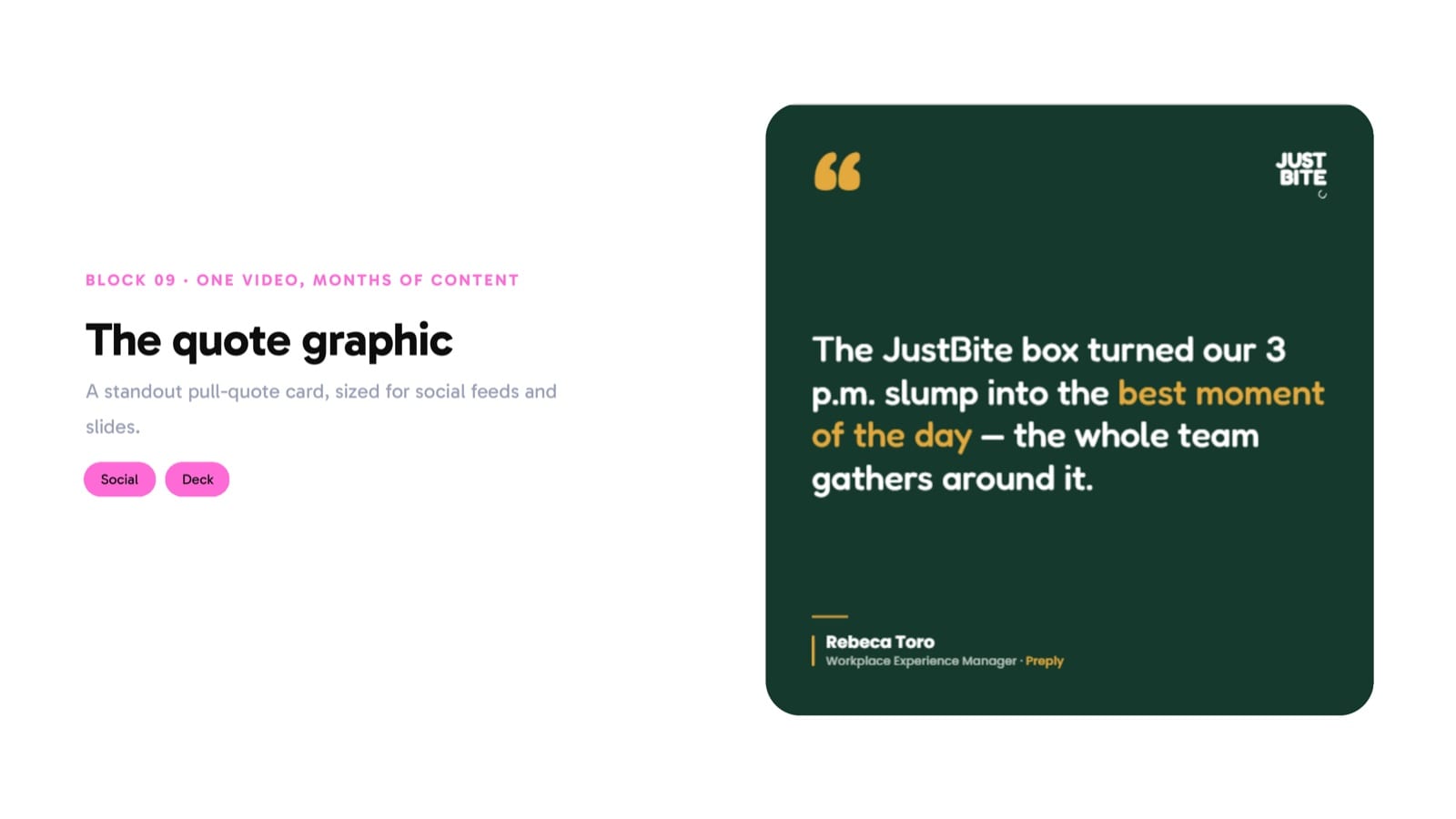
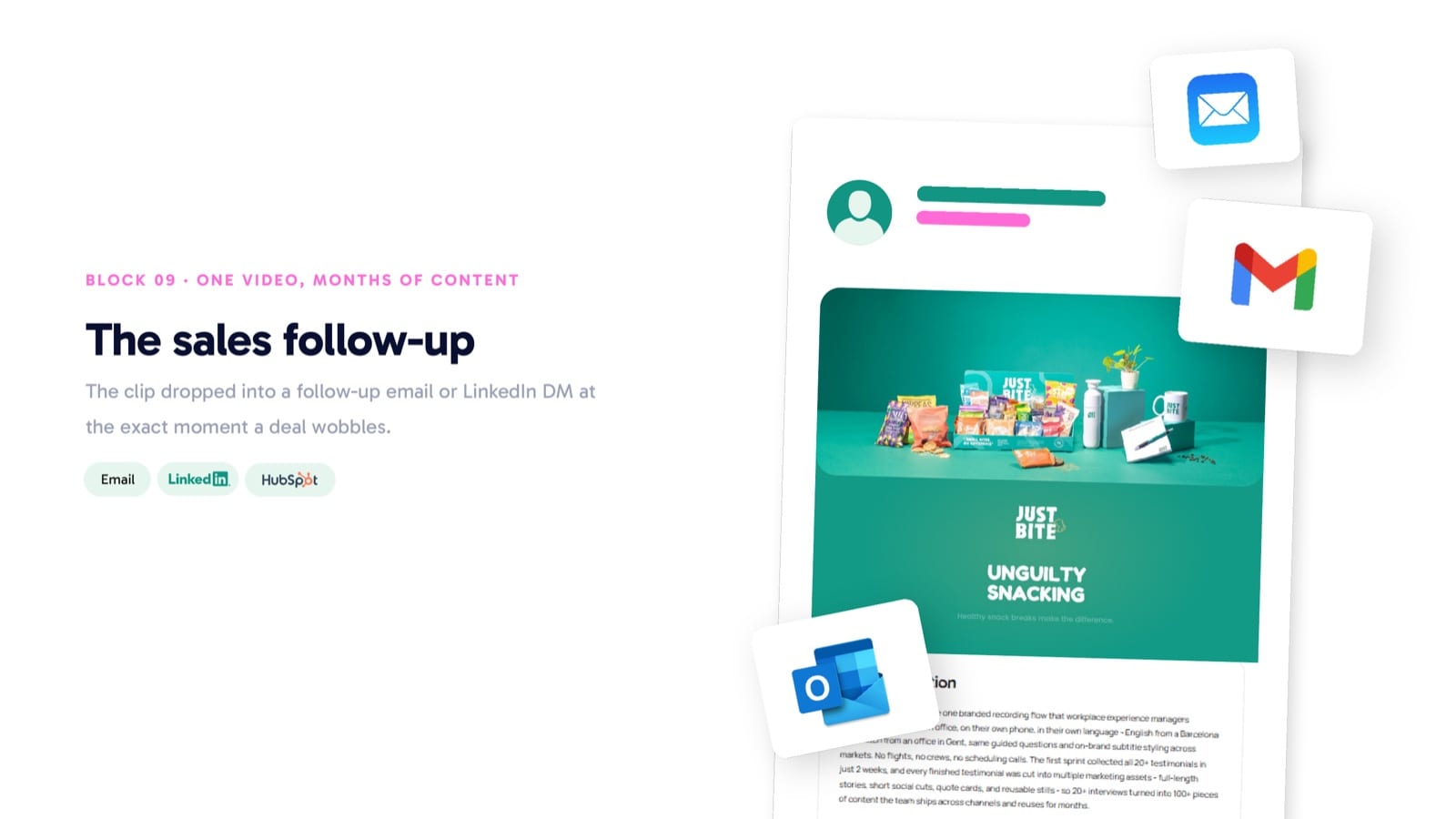
A video is never only a video.
It is photo, audio and text, built in layers. The biggest mistake teams make is collecting a great video and letting it die on a page with seven views.
Match the length to the channel
Length is not a style choice. It follows how each channel is consumed.
Chosen, committed, settles in for the long watch.
~30 seconds, or 4-5 minutes for the genuinely interested.
Tighter, ~60 seconds. You’re holding a room’s attention.
Tiny attention span. 15-30 seconds. Get to the point fast.
The optimization checklist
Five fields decide whether AI search can cite your video. Try it on your last upload.
Five fields decide whether AI search can cite your video.
Why teams miss reviews.
Of 100 happy customers, only about 10 reviews come back. 90 didn’t refuse, they got lost on the way. Every loss is fixable.
Of 100 happy customers, 90 didn’t refuse, they got lost on the way.
- Customers you forgot to ask-25%
- Asked too late-25%
- Interview or form too long-26%
- No follow-up, momentum dies-14%
Authenticity beats the polished. It doesn't need to be perfect. It just needs to be very human.
AI tools we actually use
Your questions, answered
The five best questions from the room. Yes, this doubles as our conversational FAQ.
The data says YouTube dominates today, so start there. But AI engines don’t watch video, they read the transcript, description, metadata and chapters. A self-hosted video that ships all of those is equally citable, and LinkedIn and Wistia videos with transcriptions get picked up too.
Yes, and you should. It feeds the repetition signal LLMs love: the same story present on multiple platforms strengthens the consensus around your brand.
No. The date is a claim and the content is the proof. Engines increasingly compare the old and new versions of a page: if the date changed but the text didn’t, you’re busted. Update the content, then the date.
Very carefully. Every subreddit is heavily moderated and Reddit users are allergic to sales and marketing. What works: track your keywords, get notified when a relevant thread pops up, and add a genuinely useful comment. Never astroturf.
LLMs don’t publish search volumes, so triangulate: Google Search Console query data, Reddit questions, Google’s People-also-ask, your own support tickets and sales calls, and your server logs (pages AI bots hit often). Combine those into a prompt set you monitor.
The live, in-person deep-dive lands in September.
Same duo, a cool location in Belgium. Say hi and we’ll add you to the list.
Do this Monday morning
Seven actions, both halves of the session, one working week.
- 1Upload the transcript of every video you already have, everywhere it lives.
- 2Add timestamps to every video longer than two minutes.
- 3Rewrite your one most important page answer-first, with a real FAQ.
- 4Pick your top 10 accounts and ask for a testimonial by phone this week.
- 5Wire a review ask into the 48 hours after your next win.
- 6Put a review link in everyone’s email signature today.
- 7Check which sources dominate AI answers for your niche, then show up there.
One asset does all three jobs
A transcribed, well-made customer video gets you cited by the machines, trusted by the humans, and converts on the landing page.
The full session, start to finish.